Smart Supply Chain Automation with NetSuite ERP (2026 Guide)
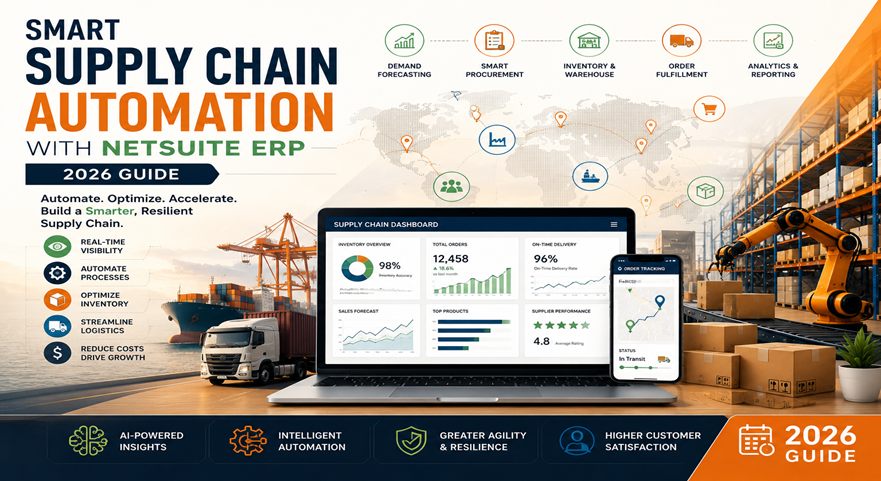
Supply chain management has become increasingly complex due to changing customer expectations, global sourcing challenges, inventory fluctuations, and rising operational costs. Businesses that still rely on manual processes often struggle with delayed shipments, stock shortages, excess inventory, and poor visibility across their operations.
This is where Smart Supply Chain Automation becomes essential. By leveraging NetSuite ERP, organizations can automate procurement, inventory management, demand planning, warehouse operations, and order fulfillment from a single cloud-based platform. Smart Supply Chain Automation helps businesses gain real-time insights, improve efficiency, and build a more resilient supply chain that supports long-term growth.
Why Businesses Need Supply Chain Automation in 2026
Modern supply chains generate enormous amounts of data every day. Managing this information manually can lead to errors and inefficiencies.
With Smart Supply Chain Automation, businesses can:
- Reduce manual data entry
- Improve forecasting accuracy
- Optimize inventory levels
- Accelerate order processing
- Improve supplier collaboration
- Increase customer satisfaction
- Minimize supply chain disruptions
NetSuite ERP enables companies to automate these processes while providing complete visibility across procurement, warehousing, logistics, and financial operations.
What is Smart Supply Chain Automation?
Smart Supply Chain Automation refers to the use of intelligent technologies, automated workflows, and real-time analytics to manage supply chain activities with minimal manual intervention.
Using NetSuite ERP, businesses can automate:
- Demand forecasting
- Inventory replenishment
- Purchase order generation
- Vendor management
- Warehouse operations
- Shipment tracking
- Supply chain reporting
This automation improves decision-making and helps organizations respond quickly to changing market conditions.
Key Features of NetSuite Supply Chain Automation
1.Real-Time Inventory Visibility
One of the biggest advantages of Smart Supply Chain Automation is real-time inventory tracking.
NetSuite allows businesses to:
- Monitor inventory across multiple locations
- Track stock movement instantly
- Reduce stockouts and overstocking
- Improve inventory accuracy
Learn more about inventory management through the Oracle NetSuite Inventory Management solution.
2.Automated Demand Planning
Accurate demand forecasting is crucial for maintaining optimal inventory levels.
NetSuite helps organizations:
- Analyze historical sales data
- Predict future demand trends
- Reduce excess inventory
- Improve procurement planning
With Smart Supply Chain Automation, businesses can make proactive decisions rather than reacting to supply chain challenges.
3.Intelligent Procurement Management
Procurement delays can significantly impact operational performance.
NetSuite automates procurement processes by:
- Generating purchase orders automatically
- Managing supplier relationships
- Tracking vendor performance
- Streamlining approval workflows
This level of Smart Supply Chain Automation ensures purchasing teams spend less time on administrative tasks and more time on strategic sourcing.
3.Warehouse Management Optimization
Warehouse efficiency directly impacts customer satisfaction.
NetSuite Warehouse Management capabilities support:
- Barcode scanning
- Mobile warehouse operations
- Automated picking and packing
- Bin management
- Cycle counting
By implementing Smart Supply Chain Automation, businesses can improve warehouse productivity and reduce fulfillment errors.
Benefits of Smart Supply Chain Automation with NetSuite ERP
Improved Operational Efficiency
Automated workflows eliminate repetitive manual tasks, reducing administrative workload and improving productivity.
Better Decision-Making
Real-time dashboards and analytics provide actionable insights into inventory levels, supplier performance, and demand forecasts.
Enhanced Customer Experience
Faster order fulfillment and accurate inventory visibility help businesses meet customer expectations consistently.
Lower Supply Chain Costs
Smart Supply Chain Automation helps reduce:
- Carrying costs
- Inventory holding costs
- Labor expenses
- Procurement inefficiencies
Increased Supply Chain Resilience
Organizations gain the flexibility needed to respond quickly to supply chain disruptions, supplier issues, and market changes.
How NetSuite Uses Data to Strengthen Supply Chains
NetSuite combines ERP, inventory management, procurement, and analytics into a unified platform.
Through Smart Supply Chain Automation, companies can:
- Monitor KPIs in real time
- Track inventory turnover
- Analyze supplier performance
- Forecast demand accurately
- Improve order fulfillment rates
For additional insights into modern supply chain strategies, visit Supply Chain Management Review and APICS Association for Supply Chain Management (ASCM).
Industries Benefiting from Smart Supply Chain Automation
Manufacturing
Manufacturers use Smart Supply Chain Automation to optimize raw material planning, production scheduling, and inventory control.
Wholesale Distribution
Distributors benefit from improved inventory visibility and automated replenishment processes.
Retail & eCommerce
Retailers leverage automation to manage inventory across stores, warehouses, and online channels.
Healthcare
Healthcare organizations use automated supply chain systems to ensure critical supplies remain available when needed.
Best Practices for Implementing Supply Chain Automation
To maximize the value of Smart Supply Chain Automation, organizations should:
- Define clear supply chain goals
- Standardize business processes
- Integrate all operational data
- Train employees effectively
- Monitor KPIs continuously
- Use predictive analytics for planning
A structured implementation approach ensures long-term success and faster ROI.
Future Trends in Supply Chain Automation
The future of Smart Supply Chain Automation will include:
- Artificial Intelligence (AI)
- Predictive analytics
- Machine learning forecasting
- IoT-enabled inventory tracking
- Autonomous warehouse operations
- Advanced supplier collaboration tools
Businesses adopting these technologies alongside NetSuite ERP will be better positioned to compete in rapidly evolving markets.
Conclusion
As supply chains become more complex, organizations require smarter and more efficient ways to manage operations. Smart Supply Chain Automation powered by NetSuite ERP enables businesses to improve inventory visibility, optimize procurement, automate warehouse management, reduce costs, and enhance customer satisfaction.
By embracing Smart Supply Chain Automation, companies can build agile, data-driven supply chains that support sustainable growth and operational excellence in 2026 and beyond.
Looking to transform your supply chain operations with NetSuite ERP?
Tech i-vin Technology specializes in NetSuite consulting, implementation, customization, integration, and support services. Our experts can help your organization implement Smart Supply Chain Automation strategies that improve efficiency, reduce costs, and accelerate business growth.
Contact Tech i-vin Technology today to discover how NetSuite ERP can revolutionize your supply chain management processes.