
NetSuite Multi-Subsidiary Management: Global Business Guide (2026)
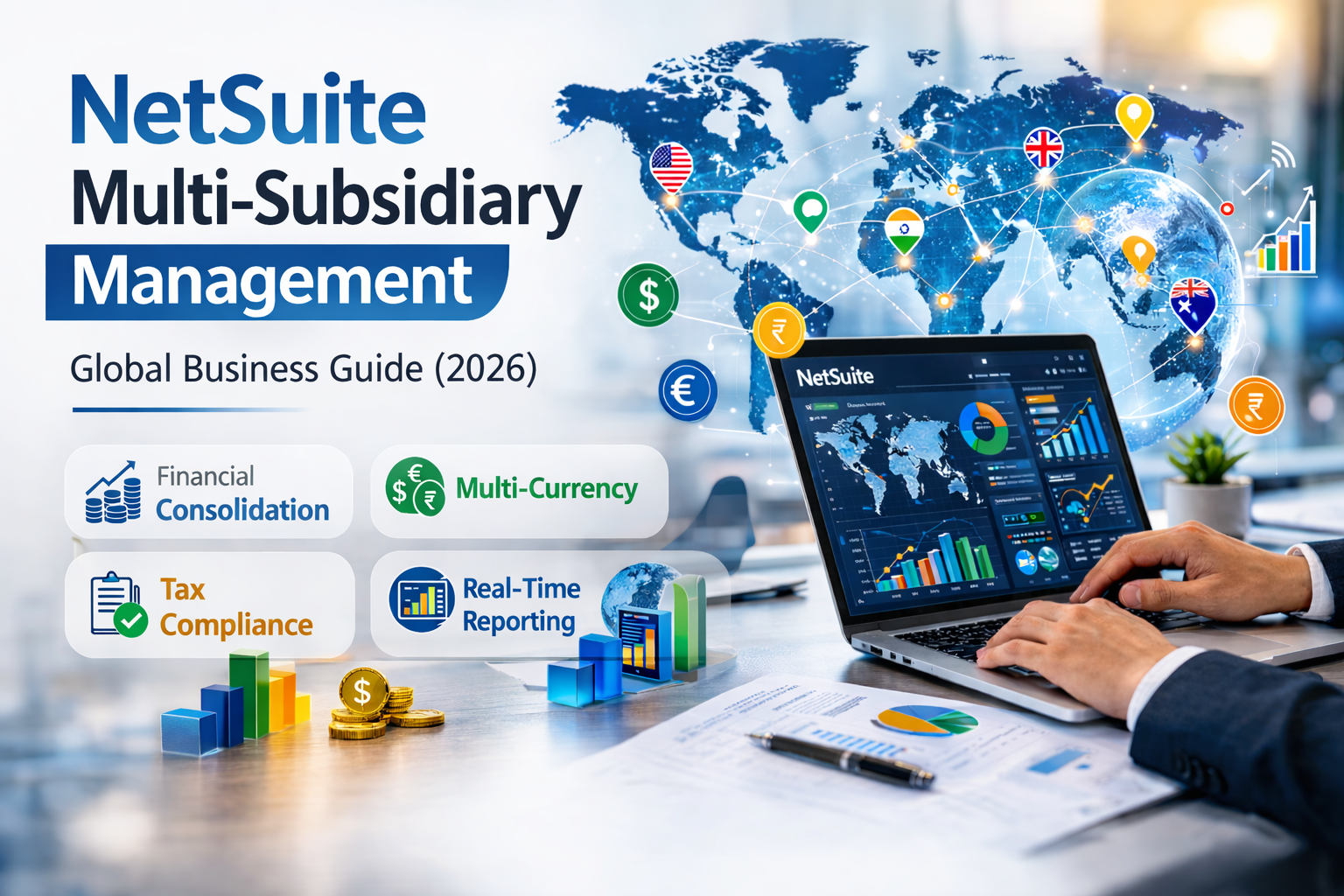
Expanding into international markets creates new operational complexity. Companies operating in multiple countries must manage different currencies, tax regulations, reporting standards, and business units. NetSuite Multi-Subsidiary Management provides a centralized ERP framework that allows organizations to manage global entities efficiently within a single platform.
With built-in financial consolidation, real-time reporting, and compliance support, NetSuite Multi-Subsidiary Management enables global companies to scale without operational chaos. Instead of maintaining separate systems for each region, organizations can unify finance, operations, and reporting under one ERP ecosystem.
Businesses using Oracle NetSuite ERP can streamline international operations, reduce accounting complexity, and gain full visibility across subsidiaries.
What is NetSuite Multi-Subsidiary Management?
NetSuite Multi-Subsidiary Management allows organizations to manage multiple legal entities, business units, or regional offices from a single cloud ERP system.
Large enterprises often operate across several countries, each with unique accounting rules and regulatory requirements. NetSuite Multi-Subsidiary Management simplifies this complexity by enabling businesses to configure subsidiaries within one centralized platform.
Key Capabilities
- Manage multiple legal entities in one ERP
- Support multiple currencies and exchange rates
- Automate financial consolidation
- Maintain local tax compliance
- Real-time global reporting
With NetSuite Multi-Subsidiary Management, finance teams can eliminate manual spreadsheets and disconnected accounting systems.
Why Global Companies Need Multi-Subsidiary ERP
Managing multiple subsidiaries using disconnected systems creates several operational challenges. Organizations often face reporting delays, compliance risks, and poor financial visibility.
NetSuite Multi-Subsidiary Management solves these issues by providing a unified financial management system for global enterprises.
Major Challenges Without a Multi-Subsidiary ERP
- Separate accounting systems for each country
- Complex currency conversion processes
- Manual financial consolidation
- Compliance risks across jurisdictions
- Limited real-time visibility into global performance
Using NetSuite Multi-Subsidiary Management, companies gain complete operational transparency while reducing administrative complexity.
Core Features of NetSuite Multi-Subsidiary Management
1.Global Financial Consolidation
Financial consolidation becomes significantly easier with NetSuite Multi-Subsidiary Management. The system automatically consolidates financial statements from multiple subsidiaries into a single report.
Businesses can generate consolidated balance sheets, income statements, and cash flow reports instantly.
Companies following international standards like IFRS Accounting Standards or US GAAP Accounting Principles can configure reporting frameworks accordingly.
2.Multi-Currency Management
International companies must deal with fluctuating exchange rates and multiple currencies. NetSuite Multi-Subsidiary Management includes automated currency conversion and exchange rate tracking.
Key benefits include:
- Real-time currency conversion
- Automated exchange rate updates
- Accurate global financial reporting
- Reduced accounting errors
This capability ensures financial consistency across all subsidiaries.
3.Local Tax Compliance
Tax rules differ significantly between countries. NetSuite Multi-Subsidiary Management helps organizations comply with regional tax regulations.
The system supports:
- VAT and GST configurations
- Country-specific tax rules
- Automated tax reporting
- Audit-ready financial records
Global companies can also integrate regulatory frameworks from organizations like the OECD International Tax Framework.
4.Real-Time Global Reporting
Decision-makers require real-time insights across all business entities. NetSuite Multi-Subsidiary Management provides dashboards and reports that show financial and operational data from every subsidiary.
Executives can view:
- Global revenue performance
- Regional profitability
- Subsidiary financial health
- Operational efficiency metrics
With NetSuite Multi-Subsidiary Management, leaders can make faster strategic decisions.
Benefits of NetSuite Multi-Subsidiary Management
Organizations implementing NetSuite Multi-Subsidiary Management gain significant operational advantages.
Key Business Benefits
- Centralized ERP for global operations
- Faster financial consolidation
- Improved compliance management
- Reduced manual accounting processes
- Real-time global reporting visibility
- Scalable ERP for international growth
Because NetSuite Multi-Subsidiary Management operates on a cloud infrastructure, companies can easily add new subsidiaries as they expand into new markets.
Industries That Benefit from NetSuite Multi-Subsidiary Management
Many global industries rely on NetSuite Multi-Subsidiary Management to manage distributed operations.
Common Industries
- Manufacturing companies with global factories
- E-commerce businesses selling internationally
- Technology companies with regional offices
- Wholesale and distribution businesses
- Consulting firms operating across countries
These organizations require a centralized system like NetSuite Multi-Subsidiary Management to maintain operational control.
Best Practices for Implementing NetSuite Multi-Subsidiary Management
To maximize the value of NetSuite Multi-Subsidiary Management, organizations should follow structured implementation strategies.
Recommended Practices
- Define subsidiary structure before implementation
- Configure currency and tax settings correctly
- Standardize global accounting processes
- Automate financial consolidation workflows
- Use dashboards for global performance monitoring
Proper implementation ensures NetSuite Multi-Subsidiary Management delivers maximum operational efficiency.
Future of Global ERP with NetSuite (2026 and Beyond)
Global business environments continue evolving rapidly. Companies expanding into international markets require scalable ERP platforms capable of handling complex operations.
NetSuite Multi-Subsidiary Management continues to evolve with AI-driven analytics, automated compliance updates, and enhanced financial reporting.
Future ERP innovations will likely include:
- AI-powered financial forecasting
- Automated regulatory compliance updates
- Global operational analytics dashboards
- Predictive financial consolidation tools
Organizations investing in NetSuite Multi-Subsidiary Management are positioning themselves for scalable global growth.
Conclusion
Managing international business operations becomes significantly easier with NetSuite Multi-Subsidiary Management. The platform enables organizations to control multiple entities, streamline financial consolidation, ensure tax compliance, and gain real-time global visibility.
Companies expanding globally require a centralized ERP capable of managing operational complexity. NetSuite Multi-Subsidiary Management provides the infrastructure needed for sustainable international growth.
If your organization is planning global expansion and needs a scalable ERP solution, implementing NetSuite Multi-Subsidiary Management can transform how your business operates across regions.
Tech i-vin Technology helps businesses successfully implement NetSuite solutions tailored to global operations, financial management, and enterprise scalability.
Contact Tech i-vin Technology to explore how NetSuite can power your global business growth.