
NetSuite Inventory Management: 2026 Optimization Guide
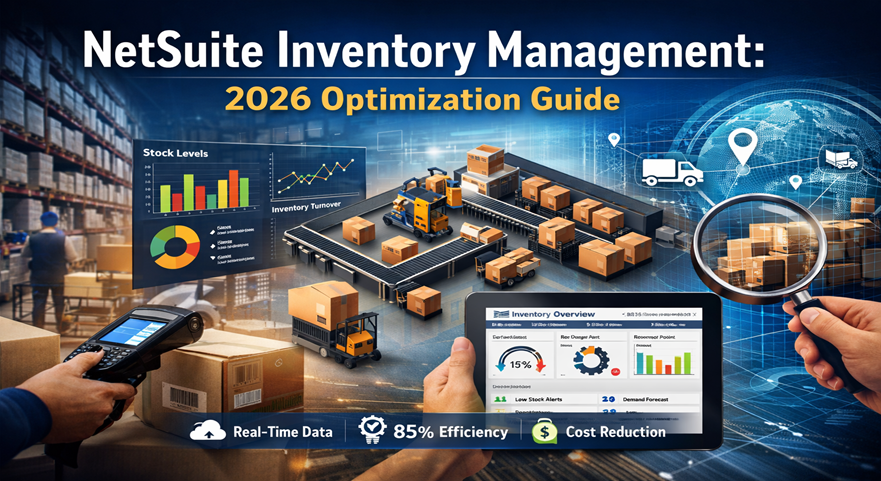
Efficient inventory control directly impacts profitability, customer satisfaction, and operational efficiency. NetSuite Inventory Management provides a centralized, real-time platform that enables businesses to track stock levels, optimize replenishment, reduce carrying costs, and prevent stockouts. This 2026 guide explores how NetSuite Inventory Management helps organizations modernize warehouse processes, improve forecasting accuracy, and build scalable supply chain operations.
As supply chains become more complex, organizations require intelligent automation and data-driven insights. NetSuite Inventory Management integrates seamlessly with financials, procurement, sales, and warehouse management to ensure end-to-end visibility and operational control.
Why Businesses Need Advanced Inventory Optimization in 2026
Global supply volatility, rising customer expectations, and cost pressures demand better inventory strategies. Traditional manual tracking systems no longer deliver accuracy or speed.
With NetSuite Inventory Management, companies can:
- Monitor stock levels in real time
- Automate replenishment rules
- Improve demand forecasting accuracy
- Reduce excess inventory and obsolescence
- Optimize warehouse picking and fulfillment
According to Gartner, real time inventory visibility significantly reduces operational inefficiencies and working capital blockage. NetSuite Inventory Management addresses these challenges with automation and intelligent reporting.
Core Features of NetSuite Inventory Management
1.Real-Time Inventory Visibility
NetSuite Inventory Management offers real time tracking across multiple locations, warehouses, and subsidiaries. Businesses can monitor:
- On-hand quantity
- Committed stock
- Backordered items
- In-transit inventory
This visibility eliminates guesswork and supports faster decision making.
Learn more about ERP inventory principles from Investopedia.
2.Automated Replenishment & Demand Planning
Forecasting errors lead to overstocking or lost sales. NetSuite Inventory Management uses historical data and predictive algorithms to automate replenishment.
Key capabilities include:
- Demand-based reorder points
- Safety stock calculations
- Preferred vendor management
- Automated purchase order generation
With proper configuration, NetSuite Inventory Management ensures optimal stock levels without manual intervention.
3.Multi-Location & Warehouse Optimization
For growing businesses, multi-location control becomes essential. NetSuite Inventory Management supports:
- Bin management
- Lot and serial number tracking
- Cycle counting automation
- Inter-warehouse transfers
Warehouse teams can use barcode scanning to update stock instantly, improving accuracy and accountability.
4.Inventory Cost Control & Financial Integration
Inventory directly affects financial reporting. NetSuite Inventory Management integrates with accounting modules to provide:
- FIFO, LIFO, and Average costing methods
- Real-time valuation reports
- COGS tracking
- Landed cost management
Integration ensures that financial statements reflect accurate inventory values at all times.
For accounting standards reference, consult IFRS guidelines.
Benefits of NetSuite Inventory Management for Growing Enterprises
Implementing NetSuite Inventory Management delivers measurable operational and financial benefits:
- Reduced stockouts and lost sales
- Lower carrying and holding costs
- Improved order fulfillment rates
- Faster warehouse processing
- Enhanced supplier coordination
- Better working capital management
Organizations leveraging NetSuite Inventory Management experience stronger supply chain resilience and scalable operations.
2026 Optimization Strategies Using NetSuite Inventory Management
To maximize ROI, businesses should focus on:
✔ Data-Driven Forecasting
Leverage predictive analytics within NetSuite Inventory Management to improve demand planning.
✔ Automation of Manual Processes
Eliminate spreadsheet dependency and automate reorder workflows.
✔ Real-Time Dashboards
Configure KPI dashboards for stock turnover ratio, fill rate, and aging inventory.
✔ Periodic Inventory Audits
Use system-driven cycle counting features in NetSuite Inventory Management to maintain accuracy.
✔ Integration with E-commerce & CRM
Sync inventory with sales platforms to avoid overselling and customer dissatisfaction.
Industry Use Cases
NetSuite Inventory Management supports various industries:
- Manufacturing
- Wholesale distribution
- Retail
- E-commerce
- Healthcare supply chain
Each sector benefits from automation, traceability, and compliance features.
Implementation Best Practices
Successful deployment of NetSuite Inventory Management requires:
- Clear inventory classification (ABC analysis)
- Defined replenishment policies
- Staff training on system usage
- Continuous performance monitoring
- Integration planning with procurement and finance
Optimization is not a one time activity. Continuous improvement ensures sustained operational excellence.
Conclusion
NetSuite Inventory Management serves as a strategic tool for businesses seeking efficiency, transparency, and cost control in 2026. By combining real-time tracking, intelligent forecasting, warehouse automation, and financial integration, NetSuite Inventory Management enables organizations to build agile and scalable supply chains. Companies that invest in optimization strategies today will gain competitive advantage, improved cash flow, and higher customer satisfaction.
If your organization is planning to optimize inventory operations, partner with experts who understand ERP transformation deeply.
Tech i-vin Technology specializes in NetSuite implementation, customization, and inventory optimization strategies tailored to industry needs.
Connect with Tech i-vin Technology to transform your inventory processes and unlock operational efficiency in 2026.