NetSuite Demand Planning: Forecasting Sales with AI in 2026
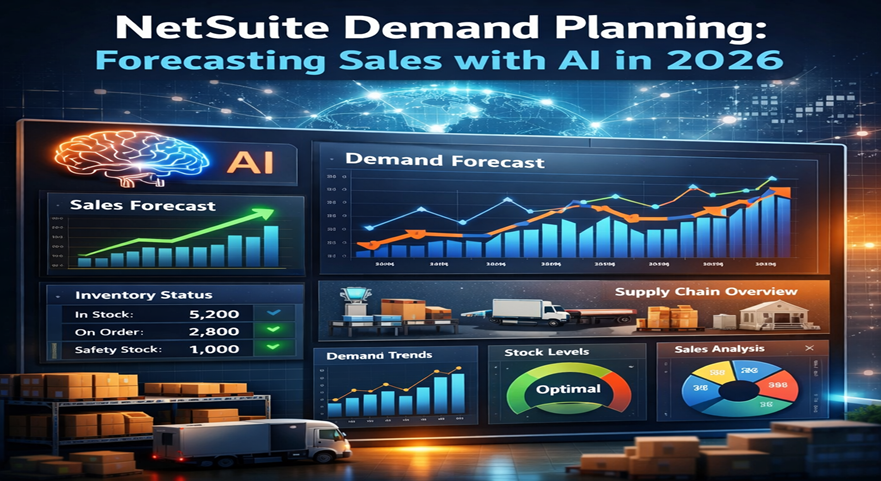
Accurate forecasting is one of the most critical aspects of modern business operations. Companies that fail to predict demand correctly often face stockouts, excess inventory, or lost revenue. NetSuite Demand Planning enables organizations to forecast demand more accurately using intelligent algorithms, historical data analysis, and AI-driven insights.
With increasing market complexity in 2026, businesses rely on NetSuite Demand Planning to automate forecasting processes, improve supply chain visibility, and align production with real demand. By combining ERP data, sales history, and predictive analytics, NetSuite Demand Planning provides businesses with smarter planning capabilities that reduce risk and increase operational efficiency.
Understanding NetSuite Demand Planning
NetSuite Demand Planning is a powerful ERP module that helps organizations forecast future product demand based on historical sales data, seasonality trends, and statistical algorithms. It automatically generates demand plans and recommends procurement or production quantities.
Businesses using NetSuite Demand Planning can improve decision-making by aligning inventory levels with predicted demand. The system evaluates multiple variables such as customer purchasing patterns, seasonal fluctuations, and sales growth trends to generate accurate forecasts.
Key capabilities include:
- Automated demand forecasting
- Historical sales analysis
- Seasonal demand adjustments
- Inventory optimization
- Supply chain visibility
- AI-based predictive analytics
For a deeper overview of ERP forecasting methods, refer to Demand Forecasting Techniques.
Why AI Is Transforming Demand Forecasting
Traditional forecasting methods relied heavily on manual spreadsheets and static calculations. However, AI-driven systems like NetSuite Demand Planning now analyze massive datasets and provide more accurate predictions.
AI enhances NetSuite Demand Planning by identifying hidden patterns within historical sales data and external market indicators. These insights allow businesses to anticipate demand spikes, seasonal changes, and emerging trends.
Benefits of AI-powered demand forecasting include:
- More accurate sales predictions
- Reduced inventory carrying costs
- Improved supply chain efficiency
- Faster planning cycles
- Better customer satisfaction
Industry studies from McKinsey Supply Chain Analytics show that companies using AI-driven forecasting can reduce inventory costs by up to 20%.
Key Features of NetSuite Demand Planning
1.Automated Demand Forecasting
One of the biggest advantages of NetSuite Demand Planning is automated demand forecasting. The system generates demand projections using historical transaction data and forecasting models.
Instead of manually calculating projections, businesses can rely on NetSuite Demand Planning to produce accurate forecasts automatically.
2.Multiple Forecasting Methods
NetSuite Demand Planning supports several statistical forecasting methods, including:
- Moving Average
- Linear Regression
- Seasonal Demand Forecasting
- Trend Analysis
These forecasting models allow organizations to select the best method for their specific products or industries.
More details about ERP forecasting models can be found on Oracle NetSuite ERP Guide.
3.Demand Planning Workbench
The demand planning workbench provides a centralized interface where planners can review forecasts, adjust demand projections, and approve planning recommendations.
Using NetSuite Demand Planning, supply chain managers can quickly analyze demand patterns and adjust forecasts when market conditions change.
This level of visibility helps organizations maintain accurate planning cycles and reduce supply chain disruptions.
4.Inventory Optimization
Inventory mismanagement is one of the most expensive operational problems businesses face. NetSuite Demand Planning improves inventory control by ensuring businesses maintain optimal stock levels.
Benefits include:
- Reduced overstocking
- Lower storage costs
- Better warehouse efficiency
- Improved order fulfillment
By integrating inventory data with NetSuite Demand Planning, companies can align supply levels with real demand forecasts.
5.Sales and Operations Alignment
Another major advantage of NetSuite Demand Planning is improved collaboration between sales, procurement, and operations teams.
The system ensures that sales forecasts are directly connected to purchasing and manufacturing plans. This integrated planning approach prevents miscommunication and improves operational coordination.
When organizations rely on NetSuite Demand Planning, they gain a unified platform for demand forecasting, supply planning, and financial projections.
Business Benefits of NetSuite Demand Planning
Companies adopting NetSuite Demand Planning gain significant operational advantages.
Improved Forecast Accuracy
AI-driven forecasting helps businesses predict demand more accurately, reducing the risk of inventory shortages.
Reduced Operational Costs
Optimized inventory planning lowers storage costs and prevents unnecessary purchasing.
Better Customer Satisfaction
When businesses maintain the right inventory levels, customer orders can be fulfilled faster and more reliably.
Faster Decision-Making
With real-time analytics, NetSuite Demand Planning enables managers to make faster and more informed decisions.
How NetSuite Demand Planning Supports Modern Businesses in 2026
The global business environment continues to become more data-driven. Companies require advanced forecasting tools to remain competitive. NetSuite Demand Planning provides the intelligence needed to predict demand patterns and respond to market changes quickly.
Organizations using NetSuite Demand Planning can integrate forecasting with financial planning, inventory management, and supply chain operations. This unified ERP approach ensures that business strategies are based on accurate demand predictions.
As AI capabilities continue to evolve, NetSuite Demand Planning will become even more powerful in helping companies forecast sales, manage supply chains, and optimize inventory.
Conclusion
Accurate forecasting is essential for efficient supply chain management. NetSuite Demand Planning enables organizations to predict sales demand, optimize inventory levels, and improve operational efficiency using AI-powered analytics.
By leveraging advanced forecasting models, real-time data insights, and automated planning tools, NetSuite Demand Planning helps businesses reduce costs, improve customer satisfaction, and make smarter decisions.
Companies looking to modernize their ERP forecasting capabilities can benefit significantly from implementing NetSuite Demand Planning as part of their digital transformation strategy.
Transform Your Demand Planning with NetSuite
If your business wants to improve forecasting accuracy, optimize inventory, and leverage AI-driven analytics, NetSuite Demand Planning can provide the solution.
Tech i-vin Technology specializes in NetSuite implementation, integration, and ERP consulting services that help organizations maximize the value of their NetSuite platform.
Connect with Tech i-vin Technology to explore how NetSuite Demand Planning can transform your supply chain and sales forecasting strategy in 2026.