How NetSuite Reduces Supply Chain Costs in 2026
Supply chain expenses continue to be one of the biggest challenges for growing businesses. Rising transportation costs, inventory carrying costs, supplier delays, and inaccurate demand forecasting can significantly impact profitability. This is where NetSuite Supply Chain Costs management capabilities become essential.
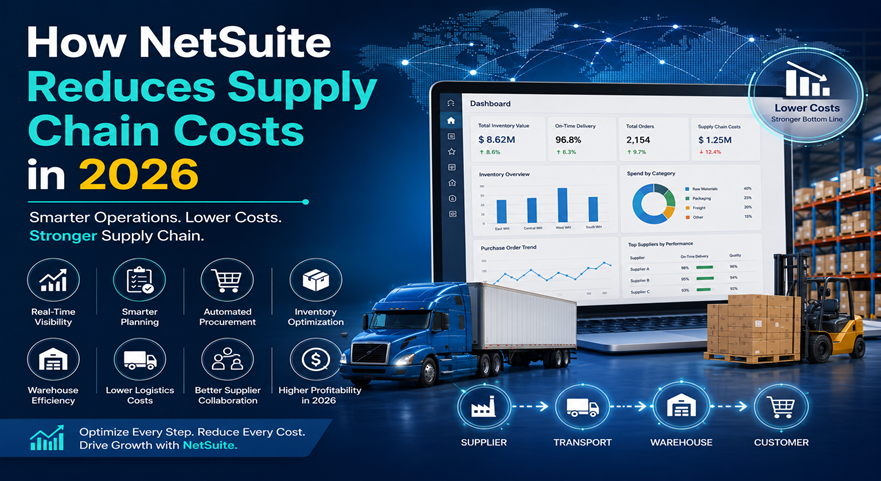
Businesses using NetSuite gain real-time visibility into inventory, procurement, warehouse operations, and supplier performance. By automating critical supply chain processes, companies can reduce waste, improve planning accuracy, and lower operational expenses. In 2026, organizations are increasingly adopting cloud ERP solutions to optimize NetSuite Supply Chain Costs and improve overall efficiency.
Why Supply Chain Cost Reduction Matters in 2026
Supply chains have become more complex due to global sourcing, changing customer expectations, and market uncertainties. Businesses that fail to control costs often face:
- Excess inventory
- Stock shortages
- Higher warehouse expenses
- Increased transportation costs
- Poor supplier management
- Reduced profit margins
Effective management of NetSuite Supply Chain Costs helps organizations maintain healthy cash flow while improving customer satisfaction.
Real-Time Inventory Visibility
One of the primary reasons companies struggle with supply chain expenses is poor inventory visibility.
NetSuite provides a centralized dashboard that offers real-time inventory tracking across multiple warehouses and locations. Businesses can instantly identify slow-moving stock, excess inventory, and replenishment requirements.
Benefits include:
- Reduced carrying costs
- Lower storage expenses
- Improved inventory turnover
- Better demand forecasting
- Fewer stockouts
By improving inventory accuracy, businesses can significantly reduce NetSuite Supply Chain Costs associated with overstocking and emergency purchasing.
👉 Oracle NetSuite Inventory Management
Smarter Demand Planning and Forecasting
Demand forecasting errors often lead to unnecessary expenses.
NetSuite uses historical sales data, trends, and forecasting tools to predict future demand more accurately. This allows businesses to purchase the right products at the right time.
Key advantages:
- Reduced excess inventory
- Better procurement planning
- Lower warehousing expenses
- Improved cash flow management
Accurate forecasting directly impacts NetSuite Supply Chain Costs by minimizing inventory waste and preventing costly stock shortages.
👉 Gartner Supply Chain Research
Automated Procurement Processes
Manual purchasing processes are time-consuming and prone to errors.
NetSuite automates procurement workflows by generating purchase orders based on inventory levels, reorder points, and forecasted demand.
Benefits include:
- Faster procurement cycles
- Reduced administrative costs
- Improved supplier communication
- Lower purchasing errors
- Better vendor negotiations
Automation helps businesses reduce operational inefficiencies while optimizing NetSuite Supply Chain Costs throughout the procurement lifecycle.
Supplier Performance Management
Supplier-related issues can quickly increase costs.
NetSuite allows organizations to monitor supplier performance through real-time metrics such as:
- Delivery accuracy
- Lead times
- Quality performance
- Cost efficiency
Businesses can identify underperforming vendors and make data-driven sourcing decisions.
Effective supplier management contributes significantly to reducing NetSuite Supply Chain Costs by improving reliability and reducing disruptions.
Warehouse Optimization
Warehouse operations represent a substantial portion of supply chain expenses.
NetSuite helps businesses optimize warehouse activities through:
- Automated picking and packing
- Barcode scanning
- Warehouse tracking
- Inventory movement monitoring
- Order fulfillment automation
These capabilities improve operational efficiency while reducing labor costs and inventory errors.
As a result, companies experience lower NetSuite Supply Chain Costs and faster order processing.
Multi-Location Supply Chain Management
Many businesses operate multiple warehouses, distribution centers, or retail locations.
NetSuite provides centralized control over:
- Inventory transfers
- Warehouse balancing
- Demand allocation
- Replenishment planning
Organizations can move inventory efficiently between locations and avoid unnecessary purchases.
This centralized approach helps reduce NetSuite Supply Chain Costs while improving inventory utilization.
Transportation and Logistics Cost Control
Shipping expenses continue to rise globally.
NetSuite enables businesses to:
- Track shipments in real time
- Optimize order fulfillment
- Improve route planning
- Reduce delivery delays
- Monitor logistics performance
These capabilities help lower freight expenses and contribute to long-term NetSuite Supply Chain Costs reduction strategies.
Data-Driven Decision Making
Modern supply chains require accurate data.
NetSuite provides advanced dashboards and reporting tools that deliver insights into:
- Inventory trends
- Supplier performance
- Procurement efficiency
- Warehouse utilization
- Logistics expenses
Decision-makers can quickly identify cost-saving opportunities and continuously improve NetSuite Supply Chain Costs management.
Key Benefits of Reducing NetSuite Supply Chain Costs
- Better inventory accuracy
- Reduced carrying costs
- Improved supplier collaboration
- Faster procurement cycles
- Lower warehouse expenses
- Enhanced demand forecasting
- Better customer satisfaction
- Increased profitability
These benefits make NetSuite Supply Chain Costs optimization a critical strategy for business growth in 2026.
Conclusion
Supply chain efficiency directly impacts profitability, customer satisfaction, and business scalability. NetSuite provides businesses with the tools needed to gain real-time visibility, automate procurement, improve forecasting, optimize warehouse operations, and strengthen supplier relationships.
Organizations focused on reducing NetSuite Supply Chain Costs can leverage NetSuite’s cloud-based ERP capabilities to streamline operations, eliminate inefficiencies, and create a more resilient supply chain. As businesses continue to face increasing operational challenges in 2026, investing in smarter supply chain management solutions becomes a competitive necessity.
Looking to reduce operational expenses and improve supply chain performance with NetSuite?
Tech i-vin Technology helps businesses implement, customize, and optimize NetSuite solutions to achieve greater efficiency and lower supply chain costs. Contact our experts today to discover how NetSuite can transform your supply chain operations and drive sustainable business growth.