Automating Lead-to-Cash Using Salesforce, NetSuite & Celigo (2026 Guide)
Lead-to-Cash Automation is transforming how businesses manage their entire revenue lifecycle—from capturing leads to collecting payments. Companies using disconnected CRM, ERP, and integration tools often face delays, manual errors, and limited visibility across departments. Automating the entire Lead-to-Cash Automation process ensures seamless data flow between sales, finance, and operations teams, helping organizations close deals faster and improve financial accuracy.
Modern organizations rely on platforms like Salesforce for CRM, NetSuite for ERP, and Celigo for integration to build a unified system. With Lead-to-Cash Automation, businesses eliminate manual data entry, accelerate order processing, and improve customer experience. This guide explains how Salesforce, NetSuite, and Celigo work together to automate the Lead-to-Cash Automation process effectively in 2026.
What is Lead-to-Cash Automation?
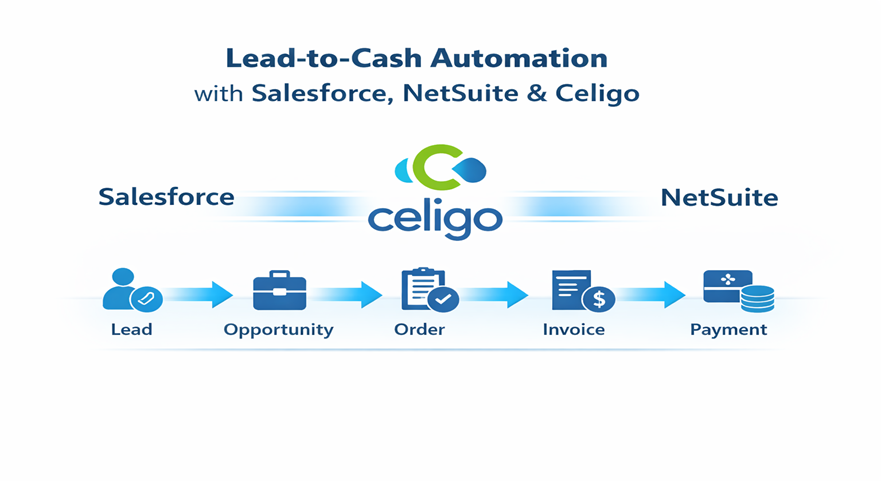
Lead-to-Cash Automation refers to the automated process that manages the entire customer journey, including lead capture, opportunity management, order processing, billing, and payment collection. It connects sales and finance workflows into a single, efficient pipeline.
Instead of manually transferring data between systems, Lead-to-Cash Automation ensures that information flows automatically and accurately across platforms.
Key stages include:
- Lead capture and qualification
- Opportunity creation and management
- Quote generation and approval
- Sales order creation
- Invoice generation
- Payment processing
- Revenue tracking and reporting
Businesses using Lead-to-Cash Automation experience faster sales cycles, improved operational efficiency, and reduced revenue leakage.
Role of Salesforce in Lead-to-Cash Automation
Salesforce CRM plays a critical role in managing customer relationships and sales activities. It helps businesses capture leads, track opportunities, and manage the sales pipeline efficiently.
Salesforce automates key processes such as:
- Lead capture from multiple sources
- Lead qualification and scoring
- Opportunity tracking
- Quote creation
- Customer data management
With Lead-to-Cash Automation, Salesforce becomes the central platform where sales teams manage customer interactions. Once a deal is closed, data is automatically transferred to NetSuite for financial processing.
Role of NetSuite ERP in Lead-to-Cash Automation
NetSuite ERP manages financial operations, order processing, billing, and revenue recognition. It ensures that sales data is accurately converted into financial transactions.
NetSuite helps automate:
- Sales order creation
- Invoice generation
- Payment tracking
- Revenue recognition
- Financial reporting
Lead-to-Cash Automation ensures that once Salesforce closes a deal, NetSuite automatically generates orders and invoices without manual intervention.
This improves accuracy and eliminates delays between sales and finance teams.
Role of Celigo Integration Platform
Celigo Integration Platform connects Salesforce and NetSuite seamlessly. It acts as a bridge that synchronizes data between CRM and ERP systems.
Celigo enables Lead-to-Cash Automation by automating:
- Customer data synchronization
- Order data transfer
- Invoice updates
- Payment status updates
- Error handling and monitoring
Celigo ensures real-time communication between Salesforce and NetSuite, which is essential for efficient Lead-to-Cash Automation.
How Salesforce, NetSuite & Celigo Work Together
Lead-to-Cash Automation becomes highly effective when these three platforms work in synchronization.
Automated workflow process:
Step 1: Lead captured in Salesforce
Salesforce captures leads from website forms, marketing campaigns, or external sources.
Step 2: Opportunity created and closed
Sales team converts the lead into an opportunity and closes the deal.
Step 3: Data automatically transferred via Celigo
Celigo transfers customer and order data to NetSuite automatically.
Step 4: Sales order created in NetSuite
NetSuite generates the sales order and invoice.
Step 5: Payment tracked and revenue recorded
NetSuite tracks payments and updates financial records.
Step 6: Status synced back to Salesforce
Sales team can see order and payment status directly in Salesforce.
This complete Lead-to-Cash Automation process ensures transparency and efficiency across teams.
Key Benefits of Lead-to-Cash Automation
Organizations implementing Lead-to-Cash Automation gain significant operational and financial advantages.
Major benefits include:
- Faster Sales Cycle
Automation eliminates manual tasks and accelerates deal closure and order processing.
- Improved Data Accuracy
Lead-to-Cash Automation removes manual entry errors and ensures consistent data across systems.
- Real-Time Visibility
Sales and finance teams can access real-time order and payment information.
- Increased Revenue Efficiency
Automation prevents delays in invoicing and revenue collection.
- Better Customer Experience
Customers receive faster order confirmations and invoices.
- Reduced Operational Costs
Automation reduces manual workload and improves productivity.
Common Challenges Without Lead-to-Cash Automation
Businesses without Lead-to-Cash Automation face several operational issues:
- Manual data entry errors
- Delayed invoice generation
- Poor coordination between teams
- Limited financial visibility
- Slower revenue recognition
Lead-to-Cash Automation eliminates these challenges by creating a fully connected ecosystem.
Why Celigo is Best for Salesforce–NetSuite Integration
Celigo provides prebuilt integration templates specifically designed for Salesforce and NetSuite.
Celigo advantages include:
- Prebuilt integration flows
- Real-time synchronization
- Error monitoring dashboard
- Scalable integration architecture
- Reduced implementation time
Celigo makes Lead-to-Cash Automation faster, more reliable, and easier to maintain.
Best Practices for Lead-to-Cash Automation Implementation
To achieve maximum success, organizations should follow proven implementation strategies.
Recommended best practices:
- Define clear sales and finance workflows
- Standardize data fields across systems
- Use prebuilt integration templates
- Monitor integration performance regularly
- Train teams on automated workflows
These practices ensure smooth Lead-to-Cash Automation implementation.
Future of Lead-to-Cash Automation in 2026 and Beyond
Lead-to-Cash Automation will continue evolving with advanced technologies like AI, predictive analytics, and intelligent automation.
Future trends include:
- AI-based sales forecasting
- Automated revenue recognition
- Intelligent workflow automation
- Real-time business insights
Businesses adopting Lead-to-Cash Automation will gain competitive advantages and operational efficiency.
Conclusion
Lead-to-Cash Automation using Salesforce, NetSuite, and Celigo provides a powerful solution for streamlining sales and financial workflows. It eliminates manual processes, improves data accuracy, and accelerates revenue generation. Organizations adopting Lead-to-Cash Automation gain better visibility, improved efficiency, and enhanced customer satisfaction.
Integrating CRM and ERP systems through Celigo enables businesses to create a fully automated revenue lifecycle, making operations faster, smarter, and more scalable.
CTA – Tech i-vin Technology
Tech i-vin Technology specializes in implementing Salesforce, NetSuite, and Celigo integrations to help businesses achieve complete Lead-to-Cash Automation. Our experts design customized integration solutions that improve operational efficiency, automate workflows, and accelerate business growth.
Contact Tech i-vin Technology to implement a scalable and future-ready Lead-to-Cash Automation solution for your organization.