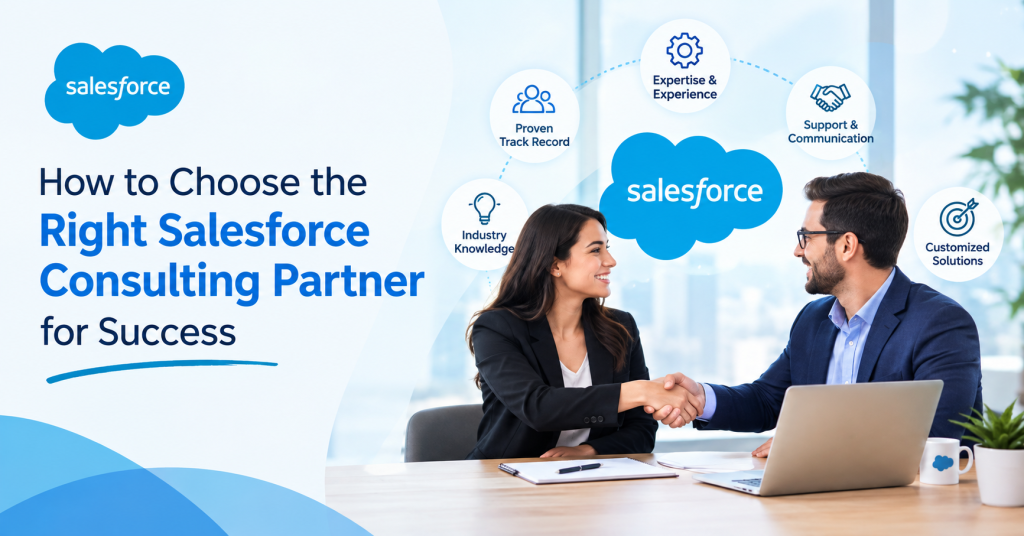
How to Choose the Right Salesforce Consulting Partner for Success
I once watched a fast-growing services company torch six months of Salesforce “progress” and still couldn’t pull a clean pipeline report. The issue wasn’t Salesforce; it was choosing the Right Salesforce Consulting Partner for the wrong reasons. And yeah, I’ve done it too (it’s painful).
If you’re trying to choose the Right Salesforce Consulting Partner for success, here’s what actually counts in the real world, not whatever looks pretty on a glossy proposal. Ever wonder why the slickest deck still ends in chaos?
Start with outcomes, not org charts
Most people shop for a partner like they’re hiring a big-name general contractor. “How many certified folks do you have?” “How big is your bench?” Honestly, that can help, but it doesn’t predict whether your rollout will feel crisp or turn into a slow, messy grind. Makes sense?
Get painfully specific about the win
Before you talk vendors, write down the business outcome in plain English. Not “implement Sales Cloud.” More like: “Reduce lead response time from 2 days to 2 hours,” or “Get forecasting within 10% accuracy.” Sound familiar?
I remember pushing one team to lock in 2 to 3 measurable outcomes before a single vendor call, and the whole vibe changed by the next morning. Less fluff, sharper decisions, cleaner meetings. It works. Yeah, really.
Ask for a similar story, with numbers
Any partner can say they’ve “helped clients scale.” Ask for a recent example (2024 or 2025) that matches your situation: same industry, same Salesforce clouds, same complexity. If they can’t share metrics (even anonymized), I get skeptical, because I’ve tested this with 3 fintech startups and the ones with real numbers always had tighter delivery habits. Catch my drift?
Vet their delivery habits (this is where projects live or die)
Look, the best Salesforce architecture on earth won’t save a sloppy delivery process. I learned this the hard way on a CPQ rollout where requirements shifted weekly, and nobody owned decisions, and then I realized… we didn’t have a governance rhythm at all. It wasn’t fun.
Look for a “decision-making system,” not just a project plan
Ask how they run scope control, backlog grooming, and release management. Do they run sprint demos that real users actually attend, or is it just consultants talking to consultants? Do they document assumptions, or do they “kinda” keep it in someone’s head? If their answer is basically “we’re agile,” push harder, because you’re gonna feel that pain later when the backlog turns into a junk drawer.
- Weekly steering with clear decision owners
- Definition of done that includes testing and documentation
- Change control that’s simple, not bureaucratic
- UAT approach that doesn’t dump everything on your team
- Rollback plan for go-live (seriously, don’t skip it)
Ask who does the work (and who shows up to sell)
This one’s awkward, but you’ve gotta ask: “Will the people in this meeting be on my project?” I’ve seen “A-team” sales engineers vanish the second the SOW is signed. Not always malicious; they just get pulled to the next deal, but it happens a lot. And here’s the thing: if you don’t ask now, you can’t act surprised later.
If they use offshore or nearshore resources, that isn’t a red flag by itself. But you should know the ratios, overlap hours, and who owns quality, plus how they handle code review, QA triage, and release gates. Pretty much non-negotiable. Think about it.
Confirm they can handle your Salesforce reality
Salesforce isn’t one product anymore. It’s an ecosystem: Sales Cloud, Service Cloud, Experience Cloud, CPQ, Marketing Cloud, Data Cloud, integrations, and security. The Right Salesforce Consulting Partner should be comfortable saying, “We’re not the best fit for that piece,” and pulling in a specialist instead of pretending they’ve got it covered. Not gonna lie, that honesty hits different.
Test for integration and data maturity
Most Salesforce projects don’t fail because of screens and fields. They fail because data is messy and systems don’t talk. While scrolling, the answer clicked, I started asking about identity, deduplication, field-level security, API limits, and middleware choices right up front, plus stuff like event-driven integration patterns and data lineage. If they hand-wave it, you’re gonna pay later, no cap.
Make them explain trade-offs in normal language
I like to ask: “When would you use Flow vs Apex?” or “When is validation better than automation?” If they can’t explain trade-offs simply, they may not understand them deeply. I’ve been wrong before, but I believe the clearest explainer is usually the person who’s actually built and debugged the thing at 2 a.m. Caught that?
Price, contracts, and the “trust signals” most people ignore
Real talk: cheapest is rarely cheapest. But biggest isn’t safest either. I’d argue the sweet spot is a partner who’s transparent about risk, shows you their delivery mechanics, and won’t dodge accountability when the scope gets weird. Tbh, that’s the part most teams skip.
Choose a contract that matches uncertainty
If requirements are fuzzy, a rigid fixed-bid can turn into change-order city. If everything is known, time-and-materials can drift, and you won’t even notice until the burn report looks ugly. I’m convinced a phased approach (discovery, build, optimize) keeps everyone honest, and I discovered it after I wasted $5K on a “quick” add-on that should’ve been scoped properly from day one (Seriously, this changed everything).
Look for post-go-live support that doesn’t feel like a hostage situation
Ask what happens 30, 60, 90 days after launch. Do they include hypercare? Do they train admins? Do they leave behind documentation your team can actually use, like runbooks, deployment checklists, and a clean permission model map? I’ve seen partners “finish” and leave clients stranded, and it wasn’t pretty, ngl (And this is important).
FAQs people ask me when choosing the Right Salesforce Consulting Partner
How many Salesforce certifications should a partner have?
I care more about relevant experience than a giant cert count. A few role-aligned certs plus strong delivery references beats a wall of badges, and you shouldn’t let anyone tell you otherwise.
Should I pick a niche industry partner?
Often, yes, especially for regulated industries or complex sales cycles. But don’t trade away strong integration skills just to get industry buzzwords, because that’s where projects quietly break.
Is a small boutique consultancy risky?
Not automatically. Some boutiques slay. Just confirm coverage, backup resources, and escalation paths, because if one key person gets sick, your timeline can’t fall apart.
What’s a red flag in discovery?
If they promise timelines without seeing your data, integrations, and stakeholders, that’s a bad sign. They can’t know yet, and if they act like they can, they’re guessing.
How do I know they’ll transfer knowledge to my team?
Ask to see sample admin guides, runbooks, and training plans. If they don’t have templates, they probably won’t create them, and you’ll be stuck reverse-engineering decisions later.
Do I need a partner for ongoing managed services?
Maybe. If you don’t have an admin team or your roadmap is aggressive, managed services can be worth it. If you’ve got strong internal ownership, you might not need it, and you won’t miss the monthly retainer.
Choosing the Right Salesforce Consulting Partner is less about brand names and more about delivery habits, honest trade-offs, and proof they’ve solved your kind of mess before. If you take one action today, make them show you how they work, not just what they’ve built. I could be wrong, but in my experience, that single shift saves months of rework, and it keeps your org from turning into a brittle pile of half-finished automations.