
Data Archiving for High-Volume Businesses: Challenges & Solutions (2026)
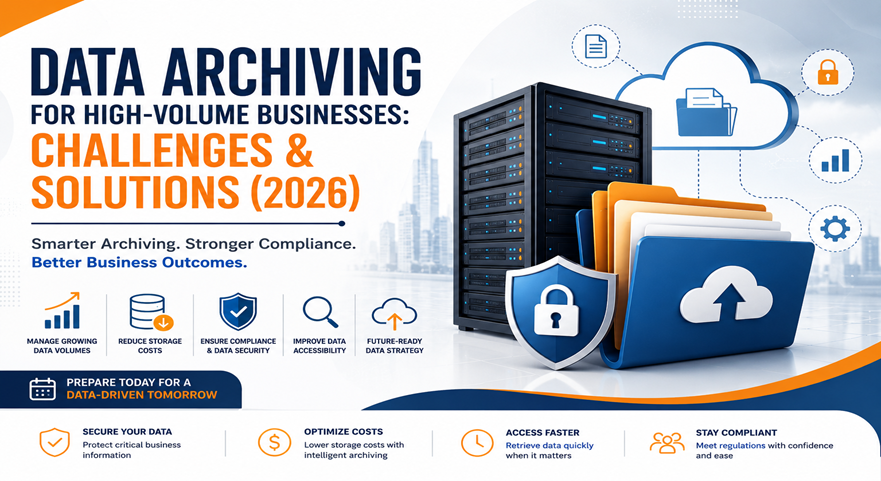
Businesses handling massive amounts of transactional, customer, operational, and financial data often face serious performance and storage issues. Data Archiving for High-Volume Businesses has become an essential strategy for organizations that want to maintain ERP speed, improve compliance, reduce infrastructure costs, and optimize long-term data management.
Large enterprises generate millions of records every year through ERP systems, CRM platforms, eCommerce operations, manufacturing processes, supply chain activities, and customer support interactions. Without a proper archive strategy, databases become overloaded, applications slow down, reporting takes longer, and compliance risks increase. This is why Data Archiving for High-Volume Businesses is now considered a core digital transformation initiative rather than just an IT maintenance task.
Organizations across industries such as retail, manufacturing, healthcare, logistics, finance, and eCommerce are investing heavily in smart archiving strategies to improve operational efficiency. Proper implementation of Data Archiving for High-Volume Businesses helps companies balance performance, security, accessibility, and scalability.
Why Data Archiving Matters for Enterprise Businesses
As enterprise data continues to grow rapidly, businesses must ensure that critical systems remain stable and responsive. Storing years of inactive records inside production databases creates multiple operational challenges.
Key Reasons Businesses Need Data Archiving
- Improves ERP and database performance
- Reduces server and storage costs
- Speeds up reporting and analytics
- Enhances compliance and audit readiness
- Simplifies backup and recovery processes
- Minimizes database maintenance overhead
- Improves scalability for future growth
- Helps manage historical business records efficiently
A well-planned Data Archiving for High-Volume Businesses strategy ensures that inactive data is safely moved to secure archive storage while remaining accessible whenever needed.
Common Challenges in Data Archiving for High-Volume Businesses
Many organizations struggle during archive implementation because enterprise systems are complex and interconnected. Understanding these challenges helps businesses avoid major operational risks.
1.Rapid Data Growth
One of the biggest problems in Data Archiving for High-Volume Businesses is exponential data growth. Enterprise applications generate continuous streams of:
- Customer transactions
- Inventory records
- Financial documents
- Vendor data
- Employee records
- System logs
- Compliance reports
- eCommerce order history
Without proper archive planning, production systems become overloaded, causing slow response times and higher infrastructure expenses.
3.Regulatory Compliance Requirements
Industries such as healthcare, finance, and manufacturing must retain records for several years due to legal and compliance regulations. Businesses cannot simply delete old data.
Organizations must follow standards such as:
- GDPR compliance
- HIPAA regulations
- SOX compliance
- Industry-specific retention policies
A structured Data Archiving for High-Volume Businesses approach ensures that archived records remain secure, traceable, and accessible for audits.
For more information about data compliance standards, businesses can refer to the clickable resources below:
4.System Performance Issues
When production databases contain excessive historical records, enterprise applications often experience:
- Slow dashboards
- Delayed reporting
- Longer query execution
- ERP lagging issues
- Backup failures
- Higher downtime risks
Proper Data Archiving for High-Volume Businesses reduces unnecessary load from active systems and significantly improves overall performance.
5.High Storage Costs
Cloud and on-premise storage costs continue to increase as enterprise data expands. Keeping inactive records in expensive production storage environments becomes financially inefficient.
A modern Data Archiving for High-Volume Businesses solution helps organizations move historical data to lower-cost storage tiers while maintaining accessibility.
6.Data Security Risks
Historical records often contain sensitive customer, employee, and financial information. Poor archive management increases the risk of:
- Unauthorized access
- Data breaches
- Compliance penalties
- Information loss
- Cybersecurity vulnerabilities
Businesses implementing Data Archiving for High-Volume Businesses must prioritize encryption, access control, authentication, and monitoring.
Best Solutions for Data Archiving for High-Volume Businesses
A successful archive strategy combines technology, governance, automation, and business policies.
Implement Intelligent Data Classification
Not all business data should be archived immediately. Organizations should classify information based on:
- Business value
- Retention requirements
- Frequency of access
- Compliance regulations
- Operational relevance
This helps businesses create smarter archive rules and optimize storage efficiency.
Use Automated Archiving Policies
Manual archive processes increase the chances of human error. Automated policies allow businesses to:
- Archive inactive records automatically
- Schedule periodic data movement
- Reduce administrative workload
- Improve consistency
- Maintain compliance standards
Automation plays a critical role in modern Data Archiving for High-Volume Businesses strategies.
Adopt Cloud-Based Archive Storage
Cloud platforms provide scalability and cost optimization for enterprise archive management.
Benefits include:
- Flexible storage expansion
- Reduced infrastructure costs
- Better disaster recovery
- Enhanced accessibility
- Improved security controls
Cloud-driven Data Archiving for High-Volume Businesses solutions are especially valuable for rapidly growing enterprises.
Maintain Data Accessibility
Archived data should remain searchable and accessible whenever required.
Businesses should ensure:
- Fast retrieval processes
- Search indexing capabilities
- Role-based access permissions
- Audit trail tracking
- Integration with ERP systems
A good Data Archiving for High-Volume Businesses framework balances storage optimization with operational accessibility.
Strengthen Security and Governance
Security should remain a top priority throughout the archive lifecycle.
Organizations should implement:
- End-to-end encryption
- Multi-factor authentication
- Access logging
- Retention policies
- Secure backup systems
- Governance frameworks
Strong governance improves the effectiveness of Data Archiving for High-Volume Businesses and reduces compliance risks.
Industry Use Cases of Data Archiving
Retail and eCommerce
Retail businesses generate massive order histories, customer records, and inventory data daily. Efficient Data Archiving for High-Volume Businesses helps retailers maintain fast transaction processing while securely storing historical sales data.
Manufacturing Industry
Manufacturers handle production records, quality reports, machine logs, and supply chain data. Archiving helps reduce ERP load while maintaining historical traceability.
Healthcare Sector
Healthcare organizations must securely retain patient records for long periods while complying with strict regulations.
Financial Services
Banks and financial institutions require secure archival systems for transaction records, audit documents, and compliance reporting.
Key Benefits of Data Archiving for High-Volume Businesses
Organizations implementing a structured archive strategy gain several long-term advantages.
Improved Operational Efficiency
Efficient Data Archiving for High-Volume Businesses reduces database clutter and improves system responsiveness.
Lower Infrastructure Expenses
Businesses can significantly reduce expensive production storage usage.
Faster Backup and Recovery
Smaller active databases reduce backup times and improve disaster recovery performance.
Better Compliance Management
Organizations can retain records according to legal requirements while maintaining secure access.
Enhanced Business Scalability
A scalable archive strategy supports long-term enterprise growth without performance degradation.
Best Practices for Successful Data Archiving
Businesses should follow a structured implementation approach.
Recommended Best Practices
- Define clear archive policies
- Create retention schedules
- Use automation wherever possible
- Regularly monitor archive performance
- Conduct security audits
- Ensure compliance validation
- Maintain proper documentation
- Test archive recovery processes
- Integrate archive systems with ERP platforms
- Train employees on archive governance
Following these best practices improves the success rate of Data Archiving for High-Volume Businesses initiatives.
Future Trends in Enterprise Data Archiving
The future of enterprise archiving is becoming more intelligent and automated.
Emerging Trends Include
- AI-driven archive optimization
- Predictive data lifecycle management
- Cloud-native archive platforms
- Real-time compliance monitoring
- Automated governance systems
- Advanced cybersecurity integration
- Hybrid cloud archive strategies
Modern organizations are increasingly adopting AI-powered Data Archiving for High-Volume Businesses solutions to improve operational efficiency and reduce risks.
Conclusion
As enterprise data volumes continue to expand, businesses must adopt smarter and more scalable data management strategies. Data Archiving for High-Volume Businesses is no longer optional for organizations that want to maintain system performance, reduce infrastructure costs, ensure compliance, and improve operational efficiency.
A successful archive strategy requires proper planning, automation, security, governance, and scalable infrastructure. Businesses that invest in modern archiving solutions gain better control over enterprise data while supporting future growth.
Organizations looking to modernize ERP performance and enterprise data management can benefit from expert implementation strategies and customized archive solutions.
Looking to implement secure and scalable Data Archiving for High-Volume Businesses solutions for your organization?
Tech i-vin Technology helps businesses streamline ERP performance, optimize enterprise storage, improve compliance, and build efficient data management strategies tailored for modern business growth.