Salesforce vs Microsoft Dynamics: Which CRM to Choose?
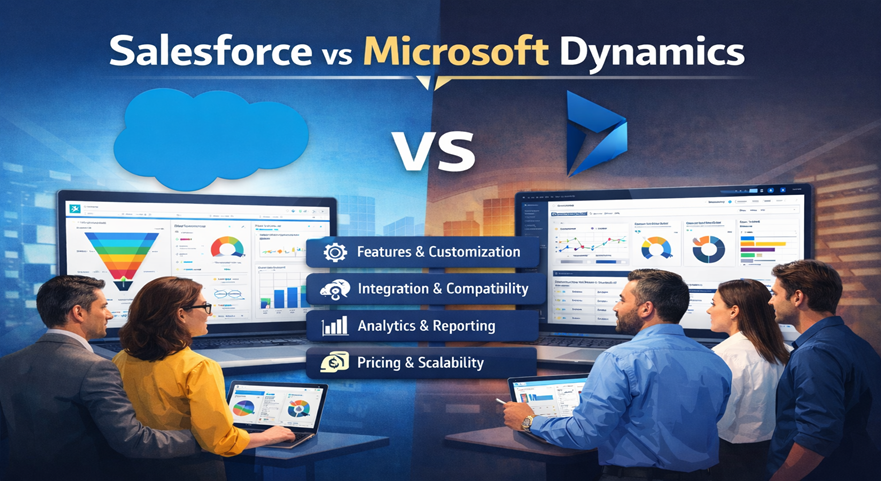
Choosing the right CRM is a strategic business decision that directly impacts sales productivity, customer experience, and long-term growth. Salesforce vs Microsoft Dynamics is one of the most common comparisons for companies evaluating enterprise-grade CRM platforms.
In this guide, we break down Salesforce vs Microsoft Dynamics across usability, features, integrations, pricing, customization, and ideal use cases—so you can confidently decide which CRM fits your organization best.
Whether you’re a startup, SMB, or enterprise, understanding Salesforce vs Microsoft Dynamics will help you avoid costly implementation mistakes and select a platform that truly supports your business goals.
What Is Salesforce CRM?
Salesforce is a cloud-based CRM platform known for its powerful Sales Cloud, Service Cloud, Marketing Cloud, and vast AppExchange ecosystem.
It is widely adopted across industries due to:
- Strong automation capabilities
- Advanced analytics and AI (Einstein)
- Massive third-party app marketplace
- Excellent scalability
You can explore core capabilities directly on the official Salesforce CRM overview (opens in new tab):
👉 Salesforce CRM platform
What Is Microsoft Dynamics CRM?
Microsoft Dynamics 365 is part of Microsoft’s broader business application ecosystem. It combines CRM and ERP modules and integrates deeply with Microsoft tools like Outlook, Teams, Excel, and Power BI.
Key strengths include:
- Native Microsoft ecosystem integration
- Flexible deployment (cloud + hybrid)
- Familiar UI for Microsoft users
- Strong ERP + CRM combination
Official product details are available here (opens in new tab):
👉 Microsoft Dynamics 365 CRM
Salesforce vs Microsoft Dynamics: Core Feature Comparison
1.User Interface & Ease of Use
Salesforce vs Microsoft Dynamics shows a clear difference in UI approach:
- Salesforce offers a modern Lightning interface with guided workflows.
- Microsoft Dynamics feels familiar to users already working in Office 365.
Verdict:
Salesforce wins for modern UX. Dynamics wins for Microsoft-native users.
2.Customization & Flexibility
When comparing Salesforce vs Microsoft Dynamics:
- Salesforce provides low-code tools (Flows, Process Builder) plus Apex for advanced customization.
- Dynamics offers Power Platform (Power Apps + Power Automate) for custom workflows.
Both are powerful—but Salesforce generally offers more CRM-specific customization out of the box.
3.Integration Capabilities
This is a critical area in Salesforce vs Microsoft Dynamics.
Salesforce:
- AppExchange with 7,000+ integrations
- Strong APIs
- Excellent third-party connectivity
Microsoft Dynamics:
- Seamless Outlook, Excel, Teams, SharePoint integration
- Strong ERP linkage
If your stack is Microsoft-heavy, Dynamics fits naturally.
If you use multiple SaaS tools, Salesforce offers broader flexibility.
4.Analytics & Reporting
In Salesforce vs Microsoft Dynamics, analytics is close:
- Salesforce: Einstein AI + customizable dashboards
- Dynamics: Power BI integration
Power BI is excellent for data visualization, while Salesforce Einstein provides predictive insights directly inside CRM.
Salesforce vs Microsoft Dynamics: Pricing Overview
Pricing varies by region and edition, but generally:
- Salesforce tends to be premium-priced with modular add-ons.
- Microsoft Dynamics offers competitive bundles, especially for Microsoft enterprise customers.
Both platforms scale in cost as features increase—so long-term TCO matters more than entry price when evaluating Salesforce vs Microsoft Dynamics.
Ideal Use Cases: Salesforce vs Microsoft Dynamics
Choose Salesforce if:
- You need advanced sales automation
- You rely on multiple third-party SaaS apps
- You want industry-specific CRM clouds
- You prioritize innovation and AI
Choose Microsoft Dynamics if:
- Your organization already uses Microsoft 365
- You want CRM + ERP in one ecosystem
- You prefer Power BI reporting
- You need tighter Office integration
Salesforce vs Microsoft Dynamics for Different Business Sizes
SMBs
- Salesforce: Faster setup, rich ecosystem
- Dynamics: Cost-effective if already on Microsoft
Mid-Market
- Both platforms perform well depending on integration needs.
Enterprise
- Salesforce excels in complex sales operations.
- Dynamics shines in finance + operations-heavy environments.
This is why Salesforce vs Microsoft Dynamics is not about which is “better”—but which aligns with your operational model.
SEO Takeaway: Salesforce vs Microsoft Dynamics
Let’s recap the key comparison points in Salesforce vs Microsoft Dynamics:
- Salesforce leads in CRM innovation and ecosystem.
- Microsoft Dynamics leads in Microsoft-native productivity.
- Both platforms support automation, analytics, and scalability.
- Your existing tech stack should guide the final decision.
Choosing between Salesforce vs Microsoft Dynamics ultimately depends on:
- Current software ecosystem
- Budget
- Customization needs
- Growth roadmap
Final Thoughts
Salesforce vs Microsoft Dynamics is a strategic CRM decision—not just a software purchase. Both platforms are industry leaders, but the right choice depends on how your teams work and how your systems connect.
If you need expert guidance on CRM selection, implementation, integration, or migration, Tech i-vin Technology helps businesses design scalable CRM solutions tailored to real-world operations.
👉 Contact Tech i-vin Technology today to start your CRM transformation journey.